Einschwingvorgänge
Processes that lead to oscillation, “Einschwingvorgänge”, in short, are not trivial to understand, because
- they bring about a qualitative change, a change from progression to repetition,
- and because they can be of very different nature.
The seminar series explores the mathematics, physics, and sound of non-linear dynamics, and in particular of oscillatory onsets. Combining sound synthesis and live coding with solvers for differential equations, we can hear and understand how different kinds of systems bifurcate and enter into oscillation.
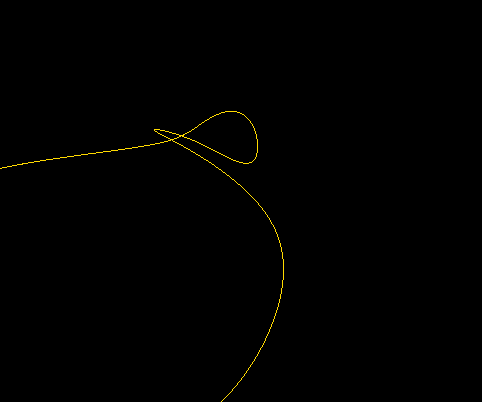
The seminar is led by Manuel Eguia, developed together with Julian Rohrhuber, with contributions by Marcus Schmickler and Dennis Scheiba. It is a cooperation between the Universidad Nacional de Quilmes (ArCiTeS / Instituto de Investigación en Arte, Ciencia, Tecnología y Sociedad + LAPSo / Laboratorio de Acustica y Percepcion Sonora) in Buenos Aires and the Institute for Music and Media in Düsseldorf.
Seminars
Einschwingvorgänge I: coming back
The first part of the series introduced oscillations in dynamical systems. We emphasised the idea that, described in differential form, there is no oscillation in a single variable on a line. This is because a system cannot return without an extra degree of freedom. This is why mechanical systems are often understood by the way position and momentum interact.
Einschwingvorgänge II: coupling
One alley for studying non-linear dynamics is to allow the coupling between oscillators: the rate of change of one oscillator depends on the state of another. In such a way, chains of very simple oscillators may form interesting behaviour.
Einschwingvorgänge III: remembering
In the third part of our series, we investigate how many other degrees of freedom can enter in the form of history, in the time evolution of a single variable. This allows oscillations and complex behaviour of a single variable to originate from negative feedback from its own past.
Sound synthesis
The demonstrations and experiments use systems for live coding and sound synthesis that express and solve differential equations in a concise and efficient way. For this, the first part of the seminar introduced Fb1_ODE by Daniel Mayer. In the third part, we use Dennis Scheiba’s DynGen which allows us to rewrite graphs quicky and calculate the real-time solutions with high numerical precision.