Rotationality
There is a minute difference between the same and the similar. Rotation embodies this difference in a particularly compact way: we always return to the same, but, often, not quite the same. Related to repetition, it is other than that.
Rotation is also an interesting methodological topic for sonification. It occupies an intermediate position between the sonification of data that come from rotational processes on the one hand, and the application of rotations to data in order to generate oscillations on the other.
In short, the concept and praxis of rotationality brings out:
- the subtle differences between repetition and rotation,
- and an awareness of both ontological and epistemic aspects of rotation.
Performances
As a way to explore how this idea unfolds in different situations, we collected a number of our works and brought them together in a composition.
At the ICAD 2026, Rotationality was played from independent laptops via local network on a supercollider server on a fixed 16-channel circle, which the audience had to squeeze in a bit.
The piece was conducted by Dennis Scheiba, performed in a rotation of power, each member as a rotating representative, taking turns twice. Each turn, an alarm clock was set to 4 min.
Paths on a spherical sphere
Joseph Baader, Sebastian Fecke
The sonification is based on an irregular, spherical triangulation of metal struts. 112 polygons, connected by 60 nodes approximate the surface of a sphere. Taking a walk along the metal struts, from one node to the next, creates a path that can be defined by certain rules (e.g. choose furthest/nearest neighbour). The resulting paths and neighbourhoods are sonified by rhythmical patterns as well as wavetable synths. The sphere and the paths on is rotated during the performance.
Turning Paleolithic
Rachel Burnhauser, Manuel Eguia, Julian Rohrhuber
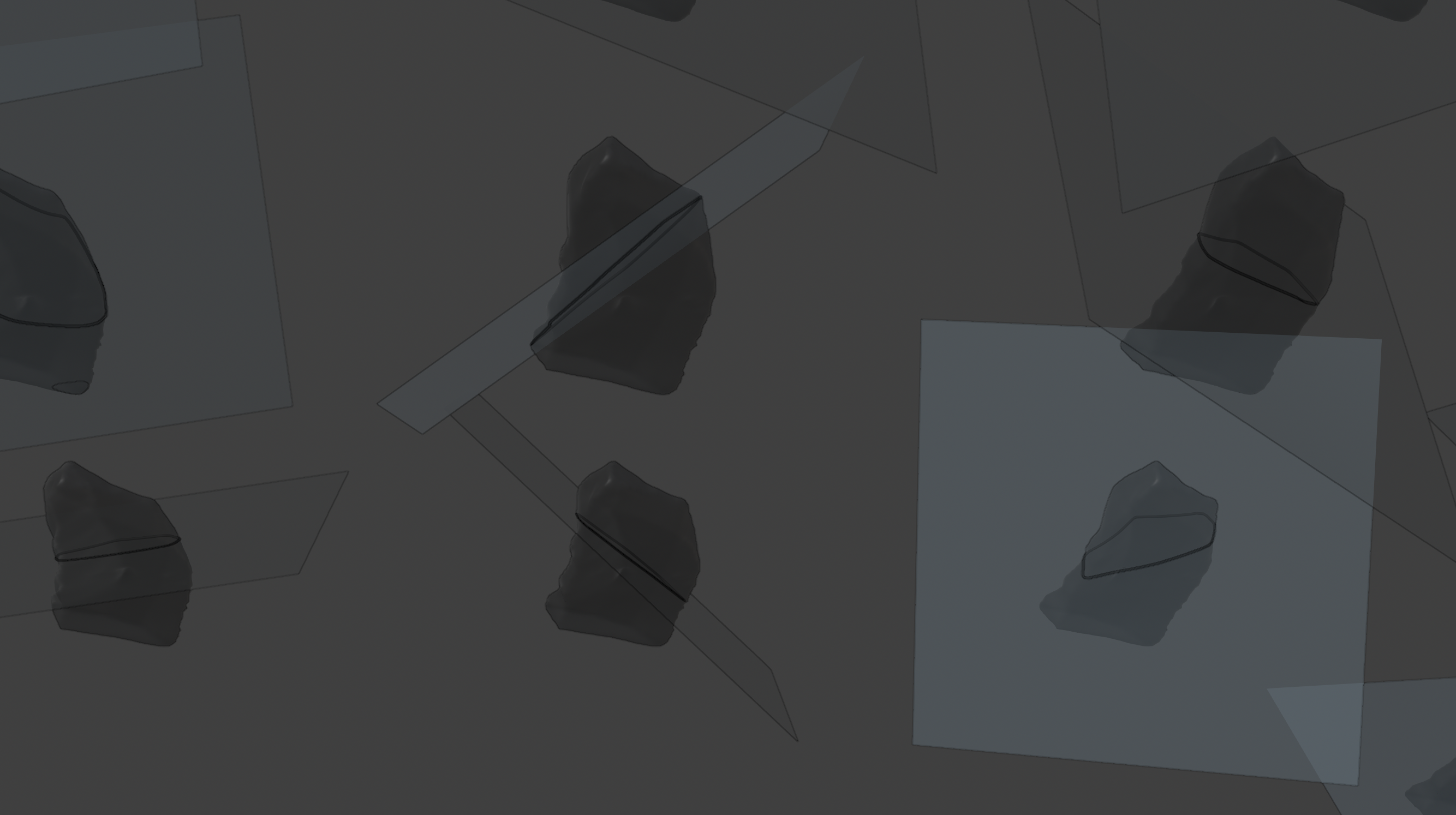
In the upper Paleolithic, 40-30 ka ago, humans were already very similar to us. Around this time, our ancestors developed new and elegant ways of shaping materials, as tools and body adornment, which have been preserved till today. Using the rotational properties of these objects, we employ a new method to sonify their precise shape. This experiment in what we call “rotational wave terrain synthesis” may lead us to notice easily overlooked properties.
Data source: Falcucci, A. & Peresani, M. (2025). The Open Aurignacian Project. Volume 1: Grotta di Fumane in northeastern Italy (Version 3.0.1). Investigating Early Upper Paleolithic Technological Variability and Cultural Dynamics South of the Alps.
Sonifying Global Winds
Jia Liu
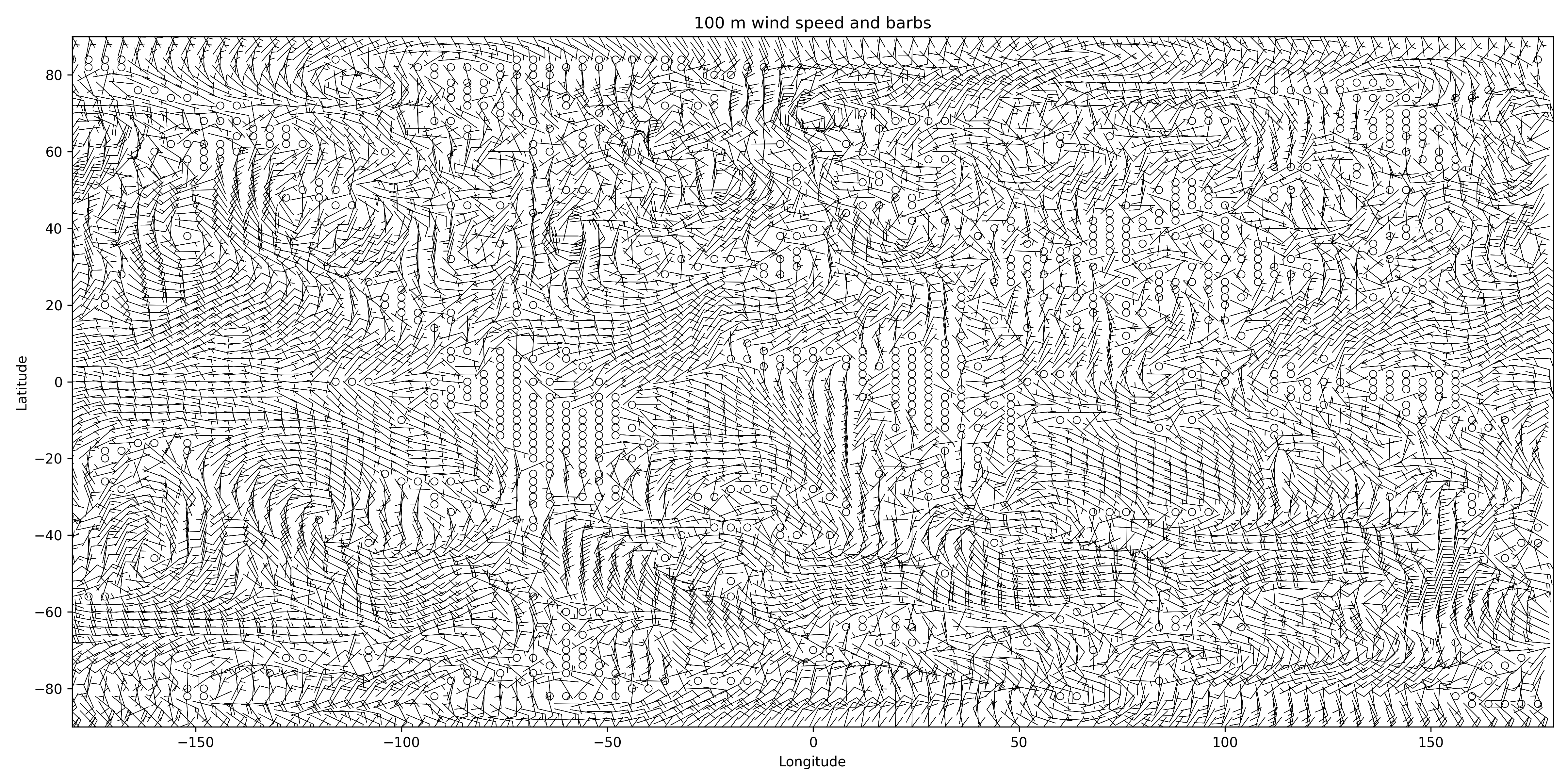
On a planetary scale, what could be grasped as wind through technological observations and mathematical predictions is a complex picture of continuous dynamic flows. Could this complex picture be displayed by sound, or could sound be displayed by this complex picture?
Two opposite approaches are explored, applying the same set of global wind vector data. One converts the data directly to a continuous audio signal, which preserves the change of complexity over time in the form of timbral change in the sound. Another uses discrete, short sound objects to display each vector, making two dimensions orientable through frequency and spectrum variations. This experiment tries to rotate the roles of data and sound in sonification process, posing interesting challenges to the epistemic quest.
The wind data are taken from ECMWF (European Centre for Medium-Range Weather Forecasts) wind vectors at 100 m above the Earth’s surface. Many thanks to Dr. Andreas Kugel for providing the formatted version and the vector visualisation.
European Centre for Medium-Range Weather Forecasts (ECMWF) Licence: CC-BY-4.0 and ECMWF Terms of Use
Rotated Differentials
David Hanraths, Matthias Schneiderbanger
As part of our artistic research we are exploring methods for the sonification of Ordinary Differential Equations (ODEs). We will present our methods and results in a short live-coded lecture performance.
How to binaurally display ODEs with more than two dimensions? One possible answer lies in the concept of rotationality. A rotation matrix allows us to change the view of our projection, such that a Z-axis becomes audible through the display on a XY plane which is mapped to a stereo speaker pair. Three-dimensional structures such as the Lorenz Attractor can be explored from all sides, both aurally and visually.
Torus knots
Joseph Baader, Shuoxin Tan
Torus knots are closed paths on the surface of a torus that seem to have inherent musical features. The knots are defined by p and q, which count the number of wrappings along each of the two circles that form a torus. p and q must be coprime integers and their relation to each other, as well as the relation between different torus knots, can be either interpreted as a scale, as intervals or as chords.
Eight Pulsars (excerpt from Bonner Durchmusterung)
Marcus Schmickler with contributions by Alberto de Campo, Carsten Goertz, and Dr. Michael Geffert. The sound synthesis was realised using a version of Pulsar Generator developed by Tommi Keränen.
Bonner Durchmusterung (2009) translates ten different sets of astronomical data and models into a 33-minute spatial electroacoustic composition, beginning from our solar system to some of the most remote objects ever collected like Gamma Ray Bursts. The excerpt presented here focuses on data from eight different pulsars, rotating neutron stars that emit electromagnetic pulses at regular intervals. Their rotational periods and temporal structures are transformed into rhythms, frequencies, and movements in sound.
Augmented Euler Disk
Lukas Buhtz
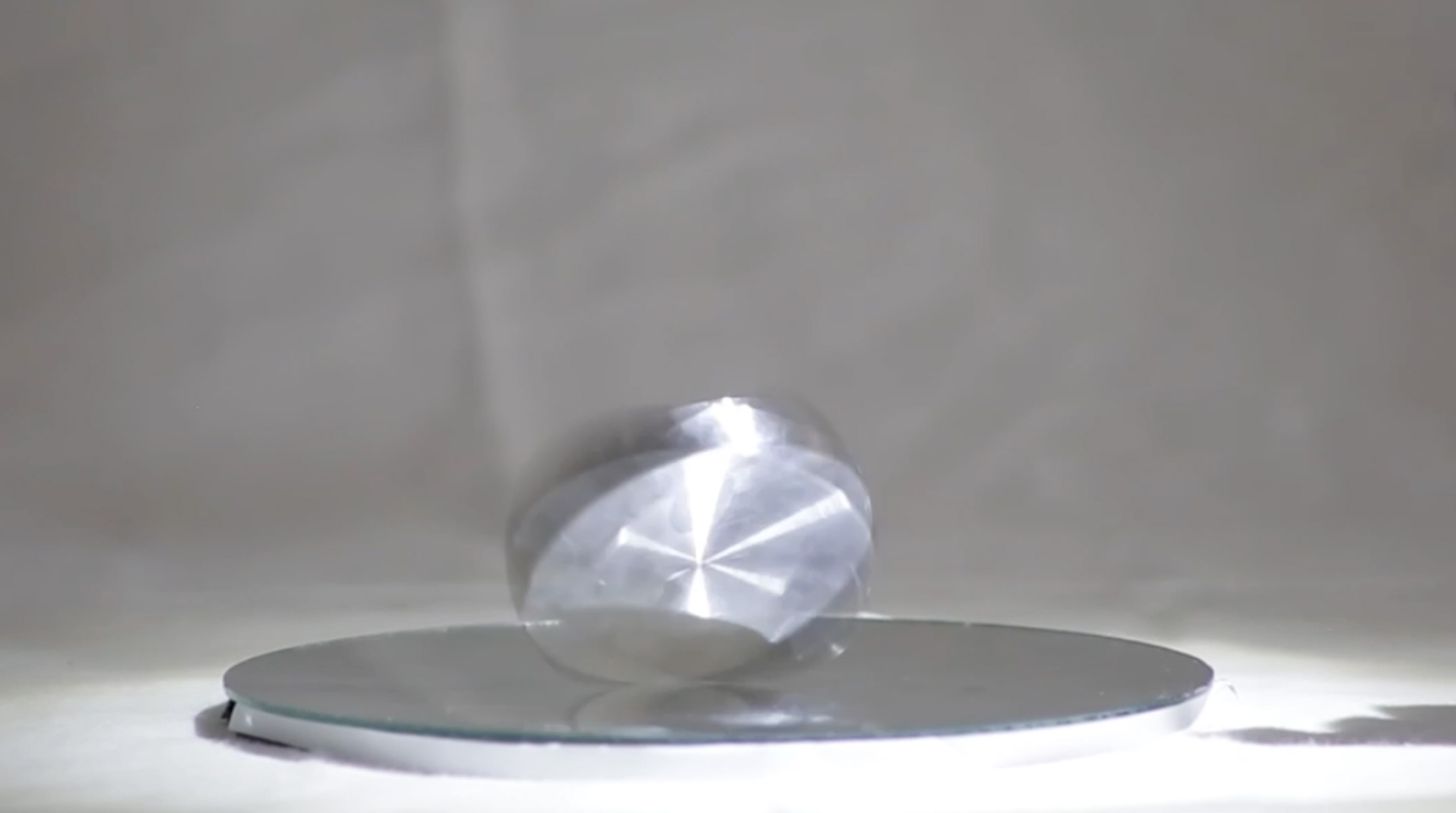
Euler’s Disk is a visual and sonic representation of the gyroscopic motion, first described mathematically by Leonhard Euler in 1750. Several aspects change simultaneously: pitch, volume, and rotational speed. The density of events increases in the process. The resulting acoustic representation reflects the dynamics of the disk’s motion as it is influenced by friction against the glass surface and air resistance.
In this way, a physical process is made audible in real-time. Phenomena occurring at a microscopic level—such as sticking effects and minute impacts invisible to the naked eye—can be perceived through sound. Additionally, as the frequency increases, the optical phenomenon known as the flicker-fusion threshold comes into play; beyond a certain speed, the eye perceives a sequence of periodic light stimuli as a continuous light source. The audible frequencies rise exponentially and the precession frequency increases sharply, while the time that remains until the disk comes to a halt decreases steadily, culminating in an abrupt decay.
 An augemented Euler Disk